Cocaine blood test in the UK: police station procedure and the 10μg/L limit
Cocaine itself is typically detectable in blood for 24 to 48 hours after a single recreational use, while its primary metabolite benzoylecgonine — the substance the UK 10μg/L drug driving limit is set on — is detectable for 2 to 4 days. Chronic users can return positive blood readings past those windows. After a positive roadside swab, UK police take a blood sample at the station under section 7 of the Road Traffic Act 1988, send it to an accredited forensic laboratory, and the result is the prosecution's primary evidence under section 5A.

 4.6Top Rated Service 2026verified by TrustindexTrustindex verifies that the company has a review score above 4.5, based on reviews collected on Google over the past 12 months, qualifying it to receive the Top Rated Certificate.


High
Client’s Success
0
Successful Cases
Start Today
Enter your details below for a free initial call.
High Success Rate
No Hidden Charges
A Truly Personal Touch
Language Support
The roadside swab is screening evidence. The blood test is the conviction evidence. If you have been charged on a station blood test reading, see the complete guide to cocaine and UK roadside drug testing for the wider picture, or speak to a cocaine drug driving solicitor.
For the full regulatory framework — including the underlying Specified Limits Regulations 2014, why the limit sits on the benzoylecgonine metabolite rather than cocaine itself, how the UK limit compares across Scotland, Wales and Northern Ireland, and what the limit means for defence strategy — see the UK cocaine drug driving legal limit guide.
How long does cocaine stay in your blood?
Cocaine has a short plasma half-life — around 90 minutes in occasional users — but its detection window is longer than that half-life implies because forensic laboratories can measure concentrations well below the levels at which the drug produces any effect. The practical UK detection windows break down as follows.
For cocaine itself in blood, a single recreational dose is typically detectable for 24 to 48 hours. Occasional weekly users sit in the 36-to-60-hour band. Daily or near-daily users can return positive blood readings up to 72 hours after the last dose, occasionally beyond. The reason chronic-use windows extend is straightforward: cocaine is lipid-soluble and accumulates in adipose tissue, from which it slowly redistributes back into plasma between doses.
For benzoylecgonine — the inactive metabolite that the UK drug driving limit is set on — the detection windows are substantially longer because the molecule is more stable and clears more slowly. Single-occasion use is detectable in blood for 2 to 4 days. Heavy use is detectable for 5 to 7 days, and in some documented cases beyond. This is the central pharmacokinetic point of UK drug driving prosecution: even after the driver has fully metabolised the cocaine and feels entirely sober, the benzoylecgonine concentration can remain above the 10μg/L limit for days.
Individual variation is real and meaningful. Body composition, hydration status, liver function, kidney function, concurrent alcohol use (which produces cocaethylene with its own profile), and genetic variation in the plasma esterases that metabolise cocaine all affect the curve. Pharmacokinetic studies report inter-individual variability of 30 to 50% even on carefully controlled doses, which is why the law does not require the prosecution to prove impairment — only that the metabolite reading was over the limit at the time the blood was drawn.
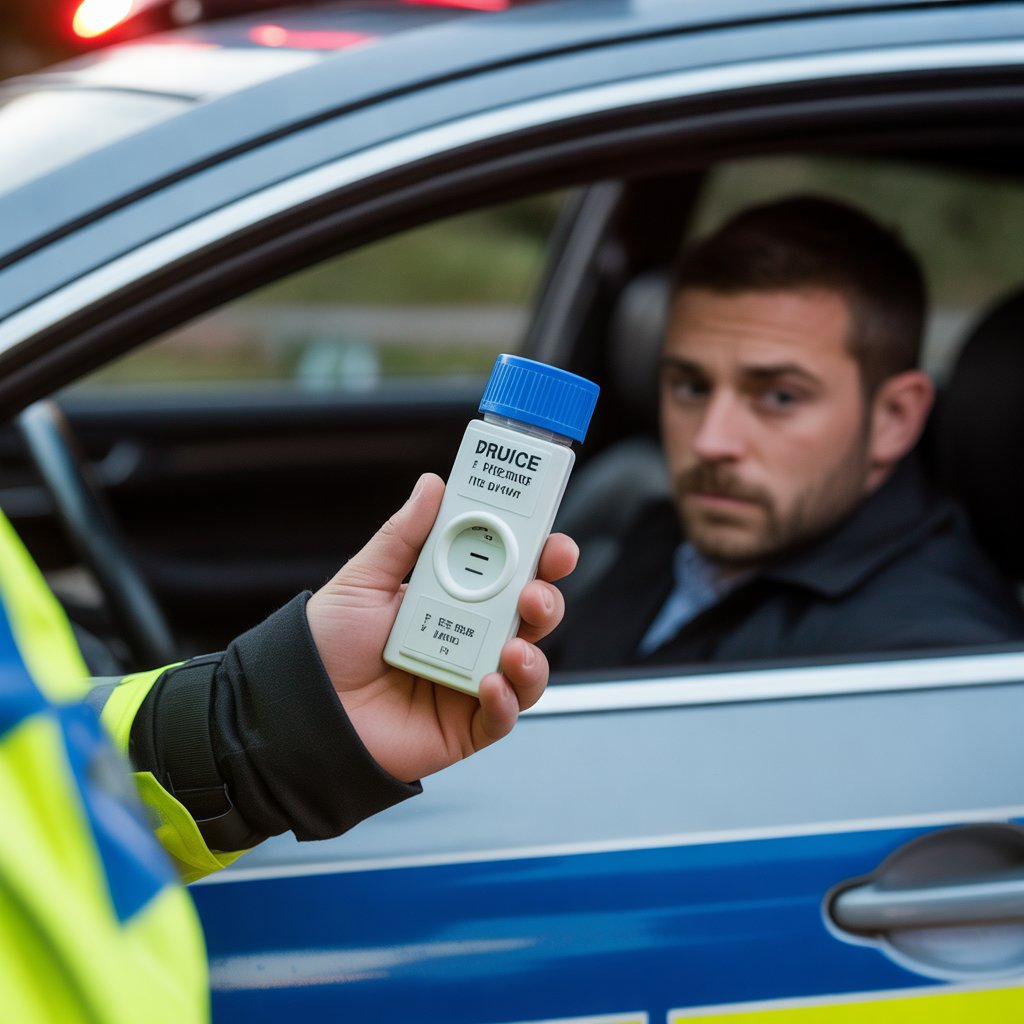
What does the UK police blood test for cocaine actually measure?
Under section 5A of the Road Traffic Act 1988, it is an offence to drive with a concentration of a specified controlled drug in the body above the specified limit. The Drug Driving (Specified Limits) (England and Wales) Regulations 2014, made under that section, set the limit for cocaine at 10 micrograms per litre of blood. Critically, that 10μg/L figure is set on benzoylecgonine, not on cocaine itself — though the same regulations also set a separate 80μg/L limit on cocaine for completeness.
Benzoylecgonine matters legally for two reasons. First, it is the dominant metabolite, formed when liver esterases and plasma butyrylcholinesterase hydrolyse cocaine within hours of use, so it is almost always present at higher concentrations than the parent drug by the time a blood sample is drawn. Second, its much longer half-life (around 6 hours, compared with cocaine’s 90 minutes) means it is a more reliable marker of recent use during the typical delay between arrest and station blood draw.
The 10μg/L threshold is set at a level the Department for Transport’s expert panel judged to be consistent with recent use that posed a road safety risk, while being above passive-exposure background levels. The threshold deliberately is not a zero-tolerance limit, which means that passive cocaine exposure — banknote handling, environmental surfaces — does not normally produce blood benzoylecgonine concentrations above the limit, and on its own is unlikely to satisfy a section 5A charge.
For the law on the limit itself in detail — its history, scope across England, Wales, Scotland and Northern Ireland, and how it compares to limits for other drugs — see the UK cocaine drug driving legal limit guide.
How is the station blood sample collected and analysed?
After a positive roadside swab under section 6 of the Road Traffic Act 1988, the driver is arrested and taken to a police custody suite. At the station, the procedure operates under section 7 of the same Act. The officer in charge of the case (or the custody sergeant) requires the driver to provide a specimen of blood or urine for analysis. Blood is the default for drug driving cases — urine is permitted only in narrow circumstances (typically medical impossibility of blood draw).
The blood draw itself must be carried out by a registered medical practitioner or a registered healthcare professional. Police officers are not permitted to take the sample. The healthcare professional draws a sample of around 6 to 10 millilitres of venous blood, typically split into two sealed containers. The first container is sent to the prosecution’s accredited forensic laboratory for analysis. The second container is offered to the driver as an optional sample for independent analysis — this is the section 15 Road Traffic Offenders Act 1988 entitlement, and accepting it is almost always the right call.
Once at the laboratory, the sample is analysed using one of two analytical methods. Older laboratory workflows use gas chromatography-mass spectrometry (GC-MS), which is highly accurate but requires derivatisation of the sample. Newer workflows use liquid chromatography-tandem mass spectrometry (LC-MS/MS), which is faster, requires less sample preparation, and has become the preferred method for UK forensic drug driving casework. Both methods are capable of resolving benzoylecgonine concentrations well below the 10μg/L limit with measurement uncertainties typically reported in the 10 to 15% range.
The full chain of custody from the moment the sample leaves the driver’s arm to the moment the analyst reports the result is documented and signed off at every transfer. Any break in that chain — an undocumented transfer, a temperature excursion during transport, a missing seal — is a defence opportunity. UK forensic laboratories operate under ISO 17025 accreditation, and the laboratory accreditation status itself is sometimes a live issue in contested cases.
Sample timing matters too. The longer the gap between the alleged driving and the station blood draw, the lower the cocaine and benzoylecgonine concentrations will be by the time the sample is taken. The prosecution does not have to prove the concentration at the moment of driving — only at the moment the sample was drawn — but back-calculation arguments occasionally arise in tightly-fought cases.
If you are concerned about refusing the station blood specimen, the consequences of that decision are covered in a dedicated guide. The short version: refusal without reasonable excuse is itself an offence under section 7(6) RTA 1988 and carries the same penalty range as a section 5A conviction.
What is the UK 10μg/L benzoylecgonine limit, and how is it enforced?
The 10μg/L limit on benzoylecgonine is what UK forensic laboratories measure against in every cocaine drug driving case. In practice, the typical case file shows readings well above that figure — readings of 100 to 1,000μg/L are common in cases involving recent use, and readings above 2,000μg/L are reported regularly. Borderline cases — readings between 10 and 30μg/L — are where measurement uncertainty and analytical procedure become live defence issues, because the laboratory’s reported uncertainty range can take the true value back below the limit.
UK forensic laboratories report results in one of two ways. The first is the raw measured value followed by the measurement uncertainty (for example, “23μg/L with measurement uncertainty of ±3μg/L”). The second is the value after the measurement uncertainty has already been deducted from the raw figure to err on the side of the defendant (the “guarantee value”). Defence solicitors must check which convention the reporting laboratory has used in any given case, because the same raw measurement can sit on either side of the limit depending on the convention.
Section 5A is a strict liability offence. The prosecution does not have to show impairment, dangerous driving, or any visible effect. They only have to show that the blood reading was above 10μg/L benzoylecgonine and that the sample procedure was followed correctly. The available statutory defence under section 5A(3) is narrow: the driver had taken the drug for medical reasons, in line with directions, and the driving was not impaired. For cocaine specifically, this defence is rarely available — the small number of legitimate medical cocaine prescriptions (topical anaesthesia in ENT surgery, for example) typically do not produce benzoylecgonine concentrations above the limit hours or days later, and the dose and timing must be carefully documented.
Sentencing under section 5A follows the drug driving sentencing guidelines published by the Sentencing Council, with a minimum 12-month disqualification on first offence, fines up to level 5, and the possibility of community orders or short custodial sentences in aggravated cases. The arrest-to-court process covers the procedural steps a charged driver moves through before sentencing.
Can a cocaine blood test be wrong, and how do you challenge it?
The station blood test is the prosecution’s primary evidence, but it is not unchallengeable. Defence routes that come up regularly fall into a small number of categories.
Procedural challenges target the sample collection itself: whether the section 7 procedure was followed correctly, whether the driver was properly cautioned and informed of the right to an independent sample under section 15, whether the healthcare professional was registered, whether the containers were properly sealed and labelled. Procedural failures are surprisingly common and have produced acquittals where the substantive reading was clearly above the limit.
Chain-of-custody challenges target the period between sample collection and laboratory analysis. Documented transfers, sealed evidence bags, temperature control during transport, time-stamped custody records — all of these must be in order. A single undocumented hand-off can put the analytical result in dispute, although in practice courts will rarely throw out a result on minor procedural breaches alone.
Analytical challenges target the laboratory’s methodology: instrument calibration logs, reference material batches, analyst qualifications and accreditation, internal quality control samples run alongside the case sample. Where the case sample falls close to the 10μg/L limit, requesting full disclosure of these records is standard defence practice, because the reported measurement uncertainty can move the result below the limit.
Independent analysis of the section 15 second sample is the strongest analytical challenge available. If the driver accepted the second sample at the station, defence can instruct an independent accredited laboratory to re-test it. Discrepancies between the prosecution and defence readings — even modest discrepancies — are usable in court, and substantial discrepancies can collapse the prosecution case entirely.
For wider questions about challenging accuracy of test results, the cocaine roadside test accuracy guide covers the screening side. The screening result and the blood result are separate evidential pieces and are challenged on different grounds.
How does the blood test compare to saliva and urine for cocaine?
The three matrices used in cocaine detection in the UK each have distinct properties and uses.
| Test matrix | Typical cocaine window | Typical benzoylecgonine window | UK drug driving role |
|---|---|---|---|
| Blood (station) | 24–48 hours single use, up to 72h heavy | 2–4 days single use, up to 7 days heavy | Yes — prosecution evidence under section 5A |
| Saliva (roadside swab) | 12–48 hours single use, up to 72h heavy | Detectable but lower concentration than blood | Yes — screening only, under section 6 |
| Urine | 2–4 days single use, up to 2 weeks chronic | Up to 30 days in heavy chronic users | No — used for workplace and clinical monitoring |
| Hair (not standard) | Up to 90 days | Up to 90 days | No — used in family court, child protection |
Blood is the analytical matrix of choice for UK drug driving prosecution because it produces stable quantitative readings that map directly to the 10μg/L statutory threshold. Saliva is the screening matrix because it can be collected at the roadside non-invasively and tracks recent use closely enough to justify arrest. Urine is not used in section 5A casework — its detection window is far too long for the law’s purpose, and it would produce convictions on use that long predated the alleged driving. The full pharmacokinetic profile of the saliva detection windows sits in a dedicated guide.
A fuller technical comparison sits in the laboratory toxicology literature, but for legal purposes only blood matters at the conviction stage. The roadside swab triggers arrest; the blood test produces the prosecution. That structure is sometimes the heart of a successful defence: a positive screening result followed by a blood test below the limit is a complete answer, not a partial one. If you have already been charged on a blood test reading, the appropriate next step is to instruct drug driving solicitors experienced in cocaine casework before the first court date — defence preparation work has time windows that close quickly.
Frequently asked questions
How long does cocaine itself stay detectable in blood?
Cocaine itself — the parent drug, not the metabolite — is typically detectable in blood for 24 to 48 hours after a single recreational dose. Chronic or heavy users can return positive cocaine readings for up to 72 hours, occasionally longer. The parent drug clears faster than the metabolite because cocaine has a short plasma half-life of around 90 minutes. The UK drug driving limit is set primarily on benzoylecgonine, the metabolite, which is detectable substantially longer.
What is benzoylecgonine and why does the law focus on it?
Benzoylecgonine is the dominant inactive metabolite produced when the body breaks down cocaine. Liver esterases and plasma butyrylcholinesterase hydrolyse cocaine into benzoylecgonine within hours of use. UK drug driving law sets its primary limit on benzoylecgonine at 10 micrograms per litre of blood because the metabolite is more stable, has a longer half-life of around 6 hours, is present at higher concentrations than the parent drug by the time blood is drawn at the station, and is therefore a more reliable forensic marker than cocaine itself.
Who draws the blood sample at the police station?
Under section 7 of the Road Traffic Act 1988, a blood sample for drug driving testing must be drawn by a registered medical practitioner or a registered healthcare professional — typically a forensic medical examiner or a registered nurse. Police officers cannot take the sample themselves. The healthcare professional must use sealed, sterile equipment and follow the procedure for splitting the sample into two containers, one for prosecution analysis and one for the optional driver sample.
Can I refuse the station blood test if I’m afraid of needles?
Genuine, documented needle phobia is a possible “reasonable excuse” defence to a charge of failing to provide a specimen under section 7(6), but the bar is high and the phobia must usually be supported by medical records pre-dating the arrest. Where blood cannot be taken, police can require urine instead. Refusal without an accepted reasonable excuse is an offence in itself and carries the same penalty range as section 5A — minimum 12-month disqualification, fine, criminal record.
What is the optional second blood sample and should I always take it?
Under section 15 of the Road Traffic Offenders Act 1988, when a station blood sample is taken, the driver is entitled to receive a portion of that sample, sealed and labelled, to retain for independent analysis. This is the strongest piece of analytical evidence available to defence. Accepting the second sample is almost always the right decision, even if you are not planning to contest the charge at the time, because circumstances can change and the sample preserves the option of re-analysis at an accredited independent laboratory.
Can heavy cocaine use extend the blood detection window past 4 days?
Yes, in some cases. The standard 2-to-4-day window for benzoylecgonine applies to single-occasion or occasional users. Heavy chronic users — daily or near-daily — can return positive benzoylecgonine blood readings for 5 to 7 days after the last dose, and forensic case reports document detection beyond 10 days in extreme cases. Body composition, hydration, and metabolic factors all extend the window. This is part of why UK drug driving law uses a strict liability framework with no impairment test — the metabolite can be over the limit days after any effect has worn off.
Will a standard hospital blood test detect cocaine?
A standard NHS hospital blood test panel does not test for cocaine. Routine bloods (full blood count, liver function, kidney function, etc.) do not include drug screening. Specific toxicology panels can be ordered where clinically indicated — typically in emergency department admissions with suspected overdose or unexplained presentation — and those panels do include cocaine and benzoylecgonine. The UK police drug driving blood test is a separate procedure carried out at a custody suite under section 7 RTA 1988, sent to an accredited forensic laboratory, and is not part of routine NHS testing.
Can a low cocaine blood reading still result in conviction?
Yes, provided the benzoylecgonine reading is above 10μg/L. Section 5A is a strict liability offence — the prosecution does not have to show impairment or any effect on driving. A reading of 11μg/L is sufficient for a conviction in principle, although in practice borderline readings are vigorously contested on measurement uncertainty grounds. Where the reported value sits within or close to the laboratory’s stated uncertainty range, defence solicitors will typically secure full disclosure of analytical records and consider independent re-analysis of the section 15 second sample.