Meta pixel

How the drink drive rehabilitation course cuts your ban by 25%

A drink and drive rehabilitation course is an approved programme that reduces your driving ban by up to 25%. The court may offer you the course at sentencing. Courses typically cost between £150 and £250, run over 3 sessions across several weeks, and are available to anyone banned for 12 months or more.

High

Client’s Success

0

Successful Cases

Start Today

Enter your details below for a free initial call.

High Success Rate
No Hidden Charges
A Truly Personal Touch
Language Support

The length of your driving ban depends on your breath, blood, or urine reading. If you have been charged with a first-time drink driving offence, the minimum ban is 12 months. The court may offer you a rehabilitation course if your ban is 12 months or longer. For the full penalty breakdown by reading level, see our drink driving penalties page.

What is the drink drive rehabilitation course?

The Drink Drive Rehabilitation Course is a government-approved programme established under the Road Traffic Offenders Act 1988. It is designed to educate convicted drink drivers about the risks of alcohol-impaired driving and to provide practical strategies for avoiding reoffending.

The course covers three core areas:

  • The effects of alcohol on driving ability. Participants learn how alcohol impairs reaction time, judgment, coordination, and perception. A key focus is understanding how slowly the body metabolises alcohol and why drivers can still be over the legal limit the morning after drinking.
  • The law and its consequences. The course explains the legal framework governing drink driving, including mandatory penalties, the impact on motor insurance, employment restrictions, travel limitations, and the long-term consequences of a criminal record.
  • Strategies for change. Participants develop personal action plans to separate drinking from driving, identify high-risk situations, and build habits that prevent reoffending.

The DDRC is rehabilitative, not punitive. Research consistently shows that drivers who complete the course are less likely to reoffend, which is why the court incentivises participation through the ban reduction. The course is delivered by trained facilitators in small groups of 8 to 15 participants, in a supportive environment with no lectures or judgment.

There is no formal exam, written test, or pass/fail assessment. However, you must attend every session in full, participate meaningfully in discussions and exercises, and remain sober throughout. Course providers can refuse to issue a completion certificate if a participant is disruptive, refuses to engage, or attends under the influence of alcohol or drugs.

Request a Call Back

Fill in your name and telephone number and we will call you back. Rest assured all data transferred on scarsdalesolicitors.com is secured using a trusted SSL Certificate.

In compliance with the UK Sanctions Regime, we are prohibited from working with any sanctioned individuals or anyone linked to a sanctioned individual, or business. We therefore will carry out due diligence checks upon receiving your request against your name and nationality.

Are you a parent inquiring for a child?

Did you get breath reading?

Do you have date of hearing?

Skip the Receptionist

When to call you back?

Opening Hours: Mon - Fri: 9am to 5pm and Sat - Sun: 10am to 7pm

We are usually available within an hour's response time on weekdays from 9am until 5pm and at weekends and bank holidays 10am until 7pm. If requesting a call back outside of these hours, please note we will call you upon the office opening unless you specify a preferred time of call.

Important Note: Whilst we welcome call back requests from genuine enquirers, please note that in the event of this form being used for "prank requests" your IP address will be noted and improper use of this form will result in your IP address being reported to your ISP.

Accept our GDPR, Privacy Terms and Conditions

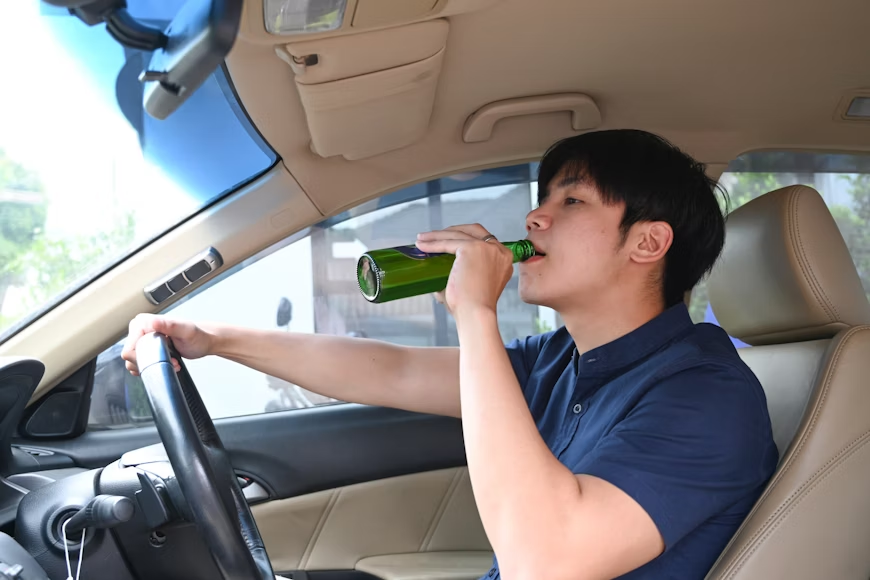
Drink Drive Rehabilitation Course Solicitors - A man holding a bottle of beer while driving

How much can the DDRC reduce your driving ban?

The DDRC reduces your driving ban by up to 25% of the original disqualification period. The court specifies the reduced end date at the time of sentencing, so you know exactly when your ban will end if you complete the course successfully.

Here is how the reduction works in practice:

Original Ban LengthBan After DDRC CompletionTime Saved
12 months9 months3 months
14 months10.5 months3.5 months
16 months12 months4 months
18 months13.5 months4.5 months
20 months15 months5 months
24 months18 months6 months
36 months27 months9 months

The reduction is calculated precisely as 25% of the total disqualification period. Your licence is returned on the reduced date once the course provider notifies the court of your successful completion.

For most people, getting back on the road even three months earlier has significant practical and financial value. It can mean keeping a job that requires driving, managing family responsibilities, and avoiding thousands of pounds in alternative transport costs.

Our drink driving penalties page explains the full range of sentences, from fines and community orders through to prison.

Who is eligible for the drink drive rehabilitation course?

Eligibility for the DDRC is determined by the sentencing court. The course is available to individuals convicted of the following offences under the Road Traffic Act 1988:

  • Driving or attempting to drive with excess alcohol (Section 5(1)(a)). This is the most common drink driving charge, including first time drink driving offences, and applies when your breath, blood, or urine alcohol level exceeds the prescribed limit.
  • Being in charge of a vehicle with excess alcohol (Section 5(1)(b)). This charge applies when you are found to be in charge of a vehicle while over the limit, even if you were not actively driving.
  • Failing to provide a specimen for analysis (Section 7(6)). Refusing or failing to provide a breath, blood, or urine sample without a reasonable excuse carries the same penalties as drink driving and the same DDRC eligibility.

The court has full discretion over whether to offer the course. Factors that influence its decision include:

  • Your alcohol reading level (very high readings may reduce the court’s inclination to offer the course)
  • Previous drink driving convictions (a second conviction within 10 years results in a minimum 3-year ban and may make you ineligible)
  • Aggravating factors such as an accident, injury to others, or driving with children in the vehicle
  • Your overall conduct and attitude during proceedings

Your solicitor matters here. At Scarsdale Solicitors, we make formal representations to the court requesting the DDRC in every eligible case, and our experience ensures those submissions carry weight.

Drink driving sentencing guidelines: ban lengths by reading

Understanding the drink driving sentencing guidelines helps you see where the DDRC fits within the overall penalty framework. The Sentencing Council guidelines for offences under Section 5 of the Road Traffic Act 1988 set out penalties that scale with the level of alcohol detected.

The following table sets out the sentencing ranges based on your evidential reading:

Breath (µg per 100ml)

Blood (mg per 100ml)

Urine (mg per 100ml)

Starting Point

Sentencing Range

Likely Ban Length

36–59

81–137

108–183

Band C fine

Band B – Band C fine

12–16 months

60–89

138–206

184–274

Band C fine

Band C fine – low community order

17–22 months

90–119

207–275

275–366

Community order

Low – high community order

23–28 months

120–150+

276–345+

367–459+

12 weeks’ custody

High community order – 26 weeks’ custody

29–36 months

Key sentencing points:

  • A Band C fine is typically 150% of your weekly income.
  • Community orders can include unpaid work, curfew requirements, supervision, and programme requirements.
  • Custodial sentences are possible for very high readings or cases with serious aggravating factors.
  • The minimum drink driving ban length for a first time drink driving offence is 12 months. For a second offence within 10 years, the minimum is 3 years.
  • Disqualification is mandatory upon conviction. The only exception is if the court accepts “special reasons” not to disqualify, learn more about how to avoid a drink driving ban, which requires expert legal argument and is granted only in exceptional circumstances.

Aggravating factors that increase sentences include previous convictions, evidence of serious impairment (swerving, erratic driving), involvement in an accident, driving with passengers, and commercial driving. Mitigating factors that reduce sentences include genuine remorse, cooperation with police, a clean driving record, and personal circumstances such as caring responsibilities or impact on employment.

This is where experienced legal representation makes the greatest difference. At Scarsdale Solicitors, we present detailed mitigation to secure the shortest possible ban and maximise your chances of being offered the DDRC. Use our drink driving penalty calculator for an estimate of your likely sentence, or schedule a free case review to discuss your situation.

For a full breakdown of how courts decide your ban length and fine, see our drink driving sentencing guidelines guide.

How the course works: step by step

The process from court to course completion follows a clear sequence. Understanding each step helps you prepare and ensures you do not miss critical deadlines.

Step 1: The court offers the course at sentencing. The Magistrates’ Court decides whether to offer the DDRC as part of your sentence. This decision is made at the sentencing hearing only, not before and not after. Your solicitor should request the course during their mitigation submissions. If the court agrees, it specifies a completion deadline.

Step 2: You accept or decline on the spot. You must decide immediately whether to accept the course. You cannot take time to consider, and you cannot change your mind after sentencing. This is why it is essential to discuss the DDRC with your solicitor before your court date, so you arrive prepared.

Step 3: You book your place with an approved provider. After sentencing, you contact an approved DDRC provider to book your place. The court may provide a list of providers, or you can find approved providers in your area through the course provider network. Book promptly, as some providers have limited availability, and you must complete the course before your deadline.

Step 4: You attend all three sessions. The course runs for approximately 16 to 20 hours across three sessions, each lasting six to seven hours, spread over several weeks. Session one covers alcohol’s effects on the body and driving ability. Session two examines the legal framework, consequences, and personal impact. Session three focuses on strategies for change, personal action plans, and goal-setting. You must attend every session. Missing even one typically means you cannot complete the course.

Step 5: You receive your certificate, and your ban is reduced. On successful completion, the course provider issues a certificate and notifies the court directly. Your ban reduction takes effect from the date specified by the court at sentencing. You do not need to return to court.


Drink drive rehabilitation course cost and locations

The drink drive rehabilitation course cost ranges from £150 to £250, depending on the provider and location. This fee is set by regulation and paid directly to the approved course provider. It is separate from legal fees, court fines, and the victim surcharge.

Approved DDRC providers operate across England and Wales, with centres in most major towns and cities. If you are searching for a drink drive rehabilitation course near you, your solicitor or the court can provide a list of approved providers in your area. Some providers offer courses at multiple venues, giving you flexibility in scheduling.

When considering the cost, the investment is straightforward:

  • A 12-month ban reduced to 9 months saves three months of alternative transport costs, which can easily exceed £1,000 in taxi fares and public transport.
  • Returning to driving sooner can protect your employment, particularly if driving is a requirement of your job.
  • The financial and personal value of additional months of driving freedom far outweighs the course fee.

For the vast majority of people, the DDRC represents excellent value. The only situation where it may not be worthwhile is if you genuinely cannot commit to attending all sessions within the deadline.

What happens if you do not complete the course?

If you accept a place on the DDRC but fail to complete it within the court-imposed deadline, the consequences are clear:

  • You serve your full, unreduced driving ban. The 25% reduction is lost, and your disqualification runs for the original period set by the court.
  • You lose the course fee. If you have already paid the course provider, there is typically no refund for non-completion.
  • There is no additional criminal penalty. You will not be fined or prosecuted for failing to complete the course. The only consequence is serving the longer ban.

The court does not normally grant extensions to the completion deadline. Illness, work commitments, and personal circumstances are generally not accepted as reasons for missing sessions. Before accepting the course at sentencing, ensure you can realistically commit to three full-day sessions and can arrange transport to the course centre without driving.

If you have any doubts about completing the course, discuss them with your solicitor before your sentencing hearing. In some cases, it may be better to decline the course and serve the full ban than to accept it and risk non-completion.

Common myths about the DDRC

Several persistent misconceptions about the DDRC lead to poor decisions. Here are the facts.

Myth: Everyone convicted of drink driving is automatically offered the course. The court has complete discretion. Defendants with very high readings, previous convictions within 10 years, or serious aggravating factors may not be offered the course. Strong mitigation from an experienced solicitor significantly increases your chances.

Myth: You can decide later whether to accept. You must accept or decline immediately at sentencing. There is no cooling-off period. Discuss the DDRC with your solicitor before your court date so you arrive prepared.

Myth: Completing the course removes the conviction from your record. The DDRC reduces your ban but does not remove the criminal conviction. Your conviction remains on your criminal record, and the DR10, DR20, or DR30 endorsement stays on your driving licence for 11 years. It must be disclosed to employers who ask, and motor insurance premiums remain significantly higher for at least five years.

Myth: The course is too expensive to be worthwhile. At £150 to £250, the course costs less than most people spend on taxis in a single month, while banned. Getting back on the road months early saves money, protects employment, and restores independence.


Myth: You do not need a solicitor if you are pleading guilty. Even when a guilty plea is inevitable, expert legal representation is essential for securing the shortest possible ban, the lowest fine, and the best chance of being offered the DDRC. Many clients who believed they had no option have been acquitted after our team identified technical defences: breathalyser calibration errors, procedural failures, or statutory time limit breaches. Always seek expert legal advice before entering any plea.

Drug driving: is there an equivalent course?

This is one of the most common questions we receive, particularly because drug driving and drink driving offences are prosecuted in the same courts and carry similar penalties. The answer is no. There is currently no drug driving rehabilitation course available in England and Wales.

The DDRC applies only to alcohol-related offences under Section 5(1)(a), Section 5(1)(b), and Section 7(6) of the Road Traffic Act 1988. It does not extend to drug driving offences prosecuted under Section 5A of the Road Traffic Act 1988, which deals with driving with a specified controlled drug above the prescribed limit.

If you are convicted of drug driving, you will serve the full disqualification period without any option for reduction through a rehabilitation course. The minimum driving ban for drug driving is 12 months, and drug driving penalties can be severe, and sentencing follows the same Sentencing Council guidelines framework that applies to drink driving.

This distinction makes expert legal representation even more important in drug driving cases, as there is no safety net of a rehabilitation course to reduce the ban. If you are facing drug driving charges, book your free consultation with Scarsdale Solicitors to explore your defence options.

Why choose Scarsdale Solicitors?

Our team handles drink driving cases daily and understands the technical and procedural details that general practitioners miss. We have over 20 years of specialist experience in road traffic law.

Our primary objective is always to secure an acquittal. We examine every aspect of your case using proven drink driving defence strategies: the stop, the breath test procedure, the calibration of the testing device, the custody process, and the evidence chain. Only if conviction is unavoidable do we focus on mitigation, including securing the DDRC.

Drink driving cases turn on technical details: breathalyser calibration records, blood sample handling procedures, statutory time limits under PACE, and police procedural requirements. We have in-depth knowledge of the Intoximeter EC/IR and Camic Datamaster devices and know how to challenge their accuracy when the evidence supports it.

We represent clients in all Magistrates’ Courts and Crown Courts across England and Wales. With over 244 verified five-star reviews and a 4.8 out of 5 rating, our clients consistently praise our expertise, responsiveness, and results. We provide clear, upfront pricing with no hidden costs.

Schedule a free case review today to discuss your drink driving charge with our specialist drink driving solicitors.

Serving Clients Across 170+ UK Locations

Expert legal services in major cities, towns, and boroughs throughout England and Wales.

North West England

Yorkshire & Humber

North East England

East of England

South West England

Frequently asked questions

Who is eligible for a drink drive rehabilitation course?
You are eligible if the court offers you the course at sentencing and your driving ban is 12 months or longer. The court is not required to offer it, but most magistrates’ courts do. You must complete the course before the reduced ban period ends, or you lose the reduction.

How much does a drink drive rehabilitation course cost?
Courses typically cost between £150 and £250, depending on the provider and your location. The fee is paid directly to the course provider, not the court. This cost is separate from any fine imposed at sentencing.

How long does the drink drive rehabilitation course take?
The course runs over 3 sessions, usually spread across several weeks. Each session lasts around 2 to 3 hours. You must attend all sessions to receive the ban reduction.

How much does the course reduce your driving ban?
Completing the course reduces your driving ban by up to 25%. For example, a 12-month ban would be reduced to 9 months, and a 24-month ban would be reduced to 18 months. The exact reduction is set by the court at sentencing.

What happens if I do not complete the rehabilitation course?
If you fail to complete the course before your reduced ban period ends, you serve the full original ban. There is no refund on the course fee. You cannot extend the deadline or transfer to a different course provider without prior court approval.

Contact Scarsdale Solicitors - Expert Drink Drive Rehabilitation Course Solicitors

If you’re facing drink driving charges or need expert advice about the Drink Drive Rehabilitation Course, contact our specialist legal team today. Moreover, Scarsdale Solicitors offer a free initial consultation to assess your case and explain your options.

Furthermore, our experienced drink drive rehabilitation course solicitors are ready to defend you with the expertise and commitment that has earned us a high success rate in motoring cases. Therefore, don’t face this challenging time alone – let us fight for your future.

Testimonials
Real stories from clients who trusted us with their most important cases. Your peace of mind is our greatest testimonial. Read what our clients share about their journey with us.
Document

I would like to thank Shazia and the Scarsdale team. Super efficient, fast responding and knew exactly what to do in the situation I was in. Highly recommend for any immigration needs

I would like to thank Shazia and the Scarsdale team. Super efficient, fast responding and knew exactly what to do in the situation I was in. Highly recommend for any immigration needs

Sherri Cronin

Dynamic Program Designer

Have You Been Arrested, Charged, Or Contacted By The Police? Every Decision You Make From This Moment Matters

Request Your FREE Consultation Now!

Please note: As a highly reputable law firm with an experienced team of solicitors, we provide paid legal services only; therefore, we kindly ask that you do not book a call if you are seeking free legal support, as we will be unable to assist and this will waste your time and ours.