Under UK drug driving law, drug driving in the United Kingdom carries a minimum 12-month driving ban, an unlimited fine, up to six months in prison, and a criminal record. These penalties apply whether it is your first offence or a repeat conviction. Under Section 5A of the Road Traffic Act 1988, introduced by the Drug Driving (Specified Limits) (England and Wales) Regulations 2014, it is an offence to drive with any of 17 specified drugs above the prescribed limit in your blood. For eight illegal drugs, the limits are set at near-zero levels, effectively making any recreational use incompatible with driving for days afterwards.
Scarsdale Solicitors’ specialist drug driving solicitors represent clients across England and Wales. Our 22-person team challenges drug driving prosecutions daily on technical and procedural grounds. If you are facing a drug driving charge, book your free consultation today. No obligation, no pressure.
What are the penalties for drug driving in the UK?
The penalties for drug driving are set out in the Road Traffic Offenders Act 1988 and the Sentencing Council’s guidelines for drug driving offences. The standard penalties on conviction are:
- Minimum 12-month driving disqualification. The court must impose at least a 12-month ban. For repeat offences within 10 years, the minimum ban increases to 36 months.
- Unlimited fine. There is no statutory cap on the fine. The court sets the amount based on your weekly income using the Sentencing Council’s fine bands (Band A, B, or C).
- Up to 6 months’ imprisonment. Custody is available for all drug driving offences at the Magistrates’ Court, though it is typically reserved for cases with aggravating factors such as an accident, very high drug levels, or passengers in the vehicle.
- Criminal record. A drug driving conviction results in a criminal record that must be disclosed on job applications, insurance renewals, and visa applications for years afterwards.
- DR80 endorsement. Your driving licence receives a DR80 endorsement code, which remains visible for 11 years from the date of conviction. This endorsement significantly increases motor insurance premiums and may result in some insurers refusing cover entirely.
- Extended retest. The court may order you to pass an extended driving test before your licence is restored, adding further cost and delay to regaining your full licence.
The maximum penalty on conviction for drug driving is six months’ imprisonment, an unlimited fine, and a driving ban of at least 12 months. The Sentencing Council’s guidelines direct courts to consider the level of drug detected, whether the driving was impaired, and any aggravating or mitigating factors when determining the sentence within this range.
A drug driving conviction also has far-reaching consequences beyond the courtroom. Your motor insurance premiums will increase by 200–500%. Countries including the United States, Canada, and Australia can refuse entry to individuals with drug-related criminal convictions. Regulated professionals (solicitors, doctors, nurses, teachers, accountants) must report criminal convictions to their regulatory body, which may initiate fitness-to-practise proceedings. If your role requires driving, you may face immediate dismissal.
Schedule a free case review to understand how these penalties may apply to your specific circumstances.
UK drug driving limits: zero tolerance thresholds
The UK operates a near-zero tolerance approach for illegal drugs under the Drug Driving (Specified Limits) (England and Wales) Regulations 2014. The specified limits for eight illegal drugs are set so low that they effectively criminalise any detectable trace of recreational use. The government’s expert panel, chaired by Dr. Kim Wolff, deliberately recommended these thresholds to sit just above the level that could result from accidental or passive exposure.
For nine prescription medications (such as morphine, diazepam, and temazepam), the limits are set at higher thresholds that correspond with normal therapeutic use. A person taking these medications as prescribed and in accordance with medical advice should not exceed the limits. However, exceeding the prescribed dose or combining medications with alcohol can push blood levels above the legal threshold.
The practical effect is stark: if you have taken an illegal drug recreationally at any point in the preceding days, you may be over the limit even if you feel completely sober and your driving is not impaired in any way.
The following table sets out the legal limits for all 17 drugs specified under the 2014 Regulations. The eight illegal drugs with near-zero limits are marked accordingly.
| Drug | Legal Limit (µg/L of blood) | Category |
|---|---|---|
| Cannabis (THC / Delta-9-tetrahydrocannabinol) | 2 µg/L | Illegal — near-zero |
| Cocaine (Benzoylecgonine) | 50 µg/L | Illegal — near-zero |
| MDMA (Ecstasy) | 10 µg/L | Illegal — near-zero |
| Ketamine | 20 µg/L | Illegal — near-zero |
| Heroin (6-Monoacetylmorphine) | 5 µg/L | Illegal — near-zero |
| LSD (Lysergic acid diethylamide) | 1 µg/L | Illegal — near-zero |
| Methamphetamine | 10 µg/L | Illegal — near-zero |
| MDA (Methylenedioxyamphetamine) | 10 µg/L | Illegal — near-zero |
| Morphine | 80 µg/L | Prescription — higher threshold |
| Diazepam | 550 µg/L | Prescription — higher threshold |
| Clonazepam | 50 µg/L | Prescription — higher threshold |
| Flunitrazepam | 300 µg/L | Prescription — higher threshold |
| Lorazepam | 100 µg/L | Prescription — higher threshold |
| Oxazepam | 300 µg/L | Prescription — higher threshold |
| Temazepam | 1,000 µg/L | Prescription — higher threshold |
| Amphetamine | 250 µg/L | Prescription — higher threshold |
| Methadone | 500 µg/L | Prescription — higher threshold |
Source: The Drug Driving (Specified Limits) (England and Wales) Regulations 2014, Schedule.
Note that the cocaine limit of 50 µg/L refers to the metabolite benzoylecgonine, not cocaine itself. Because benzoylecgonine remains in the blood long after the psychoactive effects have worn off, a person can exceed this limit 48–72 hours after last use.
How long do drugs stay in your system?
One of the most common reasons people are prosecuted for drug driving is driving the day after taking drugs, genuinely believing they are no longer affected. The near-zero limits for illegal drugs mean that substances can be detected in your blood long after any psychoactive effects have worn off.
The following table provides approximate detection windows for each illegal drug covered by the Regulations. These figures vary significantly depending on individual metabolism, body weight, hydration, frequency of use, and the quantity consumed.
| Drug | Legal Limit (µg/L) | Detection Window |
|---|---|---|
| Cannabis (THC) | 2 µg/L | 24–48 hours (occasional use); up to 7 days (heavy/regular use) |
| Cocaine (Benzoylecgonine) | 50 µg/L | Up to 72 hours |
| MDMA (Ecstasy) | 10 µg/L | 24–48 hours |
| Ketamine | 20 µg/L | 24–72 hours |
| Heroin (6-MAM) | 5 µg/L | 12–24 hours |
| LSD | 1 µg/L | 12–24 hours |
| Methamphetamine | 10 µg/L | 24–72 hours |
| MDA | 10 µg/L | 24–48 hours |
Detection windows are approximate and vary with individual metabolism, frequency of use, body composition, and hydration. These figures should not be relied upon to determine fitness to drive.
Cannabis is the most problematic drug for detection windows. THC is fat-soluble and accumulates in body tissue, meaning regular users can test positive for a week or longer after last use. The legal limit of just 2 µg/L is so low that even residual traces from days earlier can constitute an offence.
Cocaine metabolites (benzoylecgonine) remain detectable for up to 72 hours after use. A person who uses cocaine on a Friday night can exceed the 50 µg/L limit on Monday morning, a scenario Scarsdale Solicitors encounter regularly in our caseload.
MDMA is typically detectable for 24–48 hours, but high doses or repeated use can extend this period.
There is no reliable way to calculate when you will fall below the legal limit. Home drug testing kits are unreliable for determining whether you are below the specific blood concentration thresholds in the Regulations. The only safe approach is not to drive until you are certain the drug has fully cleared your system, which may be significantly longer than you expect.
Drug driving first offence UK: what to expect
A first-time drug driving offence does not attract a lighter sentence than a repeat offence. The minimum penalties are identical regardless of whether it is your first or fifth conviction: a 12-month driving ban, an unlimited fine, and a criminal record.
However, the Sentencing Council’s guidelines do treat lack of previous convictions as a mitigating factor. In practice, this means a first-time offender with no aggravating circumstances is more likely to receive:
- A 12-month ban (the statutory minimum rather than a longer period)
- A Band B fine (typically 100% of weekly income)
- A community order rather than custody
When a First Offence Leads to Harsher Sentences
The court will impose penalties above the minimum for a first offence if aggravating factors are present. These include:
- Driving was erratic, dangerous, or at excessive speed
- A road traffic accident, particularly one involving injury to another person
- Passengers in the vehicle, especially children
- Very high drug levels are significantly above the prescribed limit
- Multiple drugs were detected simultaneously in the blood sample
- Driving in a school zone or residential area during peak hours
- Evidence of dealing or possession with intent alongside the driving offence
A first offence can result in immediate custody if the court considers the offence sufficiently serious. Do not assume that being a first-time offender guarantees a lenient outcome.
If you have been charged with drug driving for the first time, book your free consultation with Scarsdale Solicitors. We will review the evidence, explain the realistic range of outcomes, and advise on the strongest available defence.
Is drug driving an instant ban?
Yes. Drug driving carries a mandatory minimum 12-month driving disqualification on conviction. Unlike some motoring offences where the court has discretion over whether to impose a ban, drug driving disqualification is compulsory under Section 34 of the Road Traffic Offenders Act 1988. The court cannot impose penalty points instead of a ban for this offence.
The only way to avoid the ban is to be acquitted of the charge, either through a successful defence at trial or by having the case discontinued by the prosecution before it reaches that stage. There is no drug driving equivalent of the drink drive rehabilitation course that allows for a reduced ban period, so the full disqualification must be served.
For repeat offenders convicted of a second drug driving or drink driving offence within 10 years, the minimum ban increases to 36 months. The court also has discretion to impose a longer ban than the minimum in any case where it considers this appropriate.
The ban takes effect immediately upon conviction. If you are dependent on your vehicle for work, childcare, or medical appointments, losing your licence for a minimum of 12 months can have devastating practical consequences that extend far beyond the legal penalties.
The “morning after” risk: when legal drug use becomes a crime
The “morning after” scenario is one of the most common situations Scarsdale Solicitors encounter in drug driving cases. A person uses drugs socially on a Friday or Saturday night, sleeps, wakes feeling normal, and drives the next day, unaware that the near-zero legal limits mean they are still committing a criminal offence.
This is not a defence. The drug driving offence under Section 5A is a strict liability offence: the prosecution does not need to prove that your driving was impaired or that you felt intoxicated. They only need to prove that the concentration of a specified drug in your blood exceeded the prescribed limit at the time you were driving.
The risk is compounded by several factors:
- No reliable self-assessment. You cannot judge your blood drug level by how you feel. The psychoactive effects of most drugs wear off long before the substance clears your bloodstream.
- No safe “wait time.” Unlike alcohol, where rough guidelines exist (though these are also unreliable), there is no established timeframe after which drug use becomes safe for driving. Individual variation is too great.
- Combining drugs and alcohol. If police detect both drugs and alcohol in your system, the prosecution can charge you with multiple offences simultaneously under Sections 4, 5, and 5A of the Road Traffic Act 1988. Each charge carries its own penalties, and the court can impose consecutive disqualification periods and separate fines.
The interaction between drugs and alcohol also increases the risk of impairment at lower levels of each substance. Even if your alcohol and drug levels are individually below the legal limits, the combined effect on your driving ability may provide evidence for a charge under Section 4 (driving whilst unfit through drink or drugs).
Police powers and roadside drug testing
Police officers have extensive statutory powers to investigate suspected drug driving. Understanding what happens if you are caught drug driving is important both for drivers and for building a defence.
Stopping your vehicle
Under Section 163 of the Road Traffic Act 1988, a uniformed police officer can stop any vehicle on a road or public place without needing reasonable suspicion of an offence. This power is unconditional; the officer does not need to explain why they stopped you.
Roadside screening
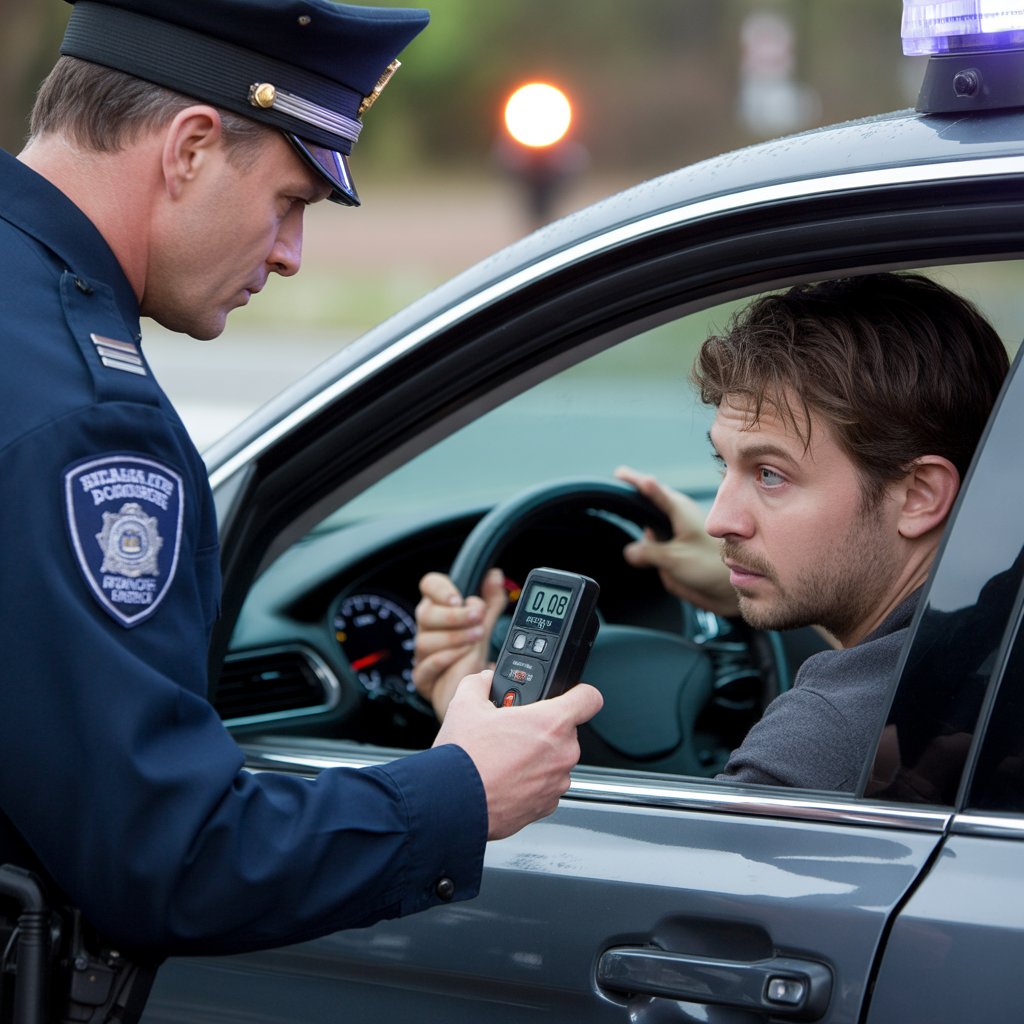
Officers use the DrugWipe device, a handheld saliva swab that tests for cannabis (THC) and cocaine. The test takes approximately 8 minutes. A positive result, or a refusal to provide a sample, gives the officer grounds to arrest you on suspicion of drug driving. Officers can also conduct a Field Impairment Test (FIT) under Section 6(5), which involves a series of physical coordination exercises: pupil examination, walk-and-turn, one-leg stand, and finger-to-nose tests. A failed FIT provides grounds for arrest even without a positive DrugWipe result. This is particularly relevant for drugs that the roadside swab cannot detect, such as MDMA, ketamine, or heroin.
Evidential blood test at the police station
A blood sample is taken by a forensic healthcare professional and sent to an accredited laboratory for analysis. This blood test, not the roadside swab, is the evidential sample on which the prosecution relies. The blood test can detect all 17 specified drugs, not just the two tested at the roadside. Under Section 7 of the Road Traffic Act 1988, refusing to provide a blood sample at the police station without a reasonable medical excuse is a separate criminal offence carrying the same penalties as drug driving itself: a minimum 12-month ban, unlimited fine, and criminal record.
Entry to the property
Under Section 6E of the Road Traffic Act 1988, officers can enter premises (including your home) to require a preliminary drug test if they reasonably suspect a person was driving or attempting to drive and has been involved in an accident.
Important for your defence: The roadside DrugWipe device is a screening tool with a known false positive rate. Environmental contamination, certain foods, and lawful medications can produce false positive results. The evidential blood test, while more reliable, is subject to strict procedural requirements around the chain of custody, storage temperature, and laboratory accreditation. Failures in any of these procedures can form the basis of a successful defence. Contact Scarsdale Solicitors for a free case review to have the evidence in your case assessed.
Causing death by drug driving: the most serious charge
Where drug driving causes a fatality, the charges escalate dramatically beyond the standard drug driving offence.
Causing death by careless driving while under the influence of drugs (Section 3A, Road Traffic Act 1988) carries a maximum sentence of life imprisonment following amendments introduced by the Police, Crime, Sentencing and Courts Act 2022 for offences committed on or after 28 June 2022. The Sentencing Council’s definitive guideline for this offence sets starting points ranging from 6 years’ custody (lower culpability) to 12 years’ custody (higher culpability), with a sentencing range extending up to 18 years before any further uplift.
Causing death by dangerous driving (Section 1, Road Traffic Act 1988) also carries a maximum of life imprisonment. If drug impairment is proven to have contributed to dangerous driving that caused a death, the court will treat this as a significant aggravating factor.
Causing serious injury by dangerous driving (Section 1A, Road Traffic Act 1988) carries a maximum of 5 years’ imprisonment, with longer sentences available where drug impairment is an aggravating factor.
In all of these cases, the driver faces mandatory disqualification for a minimum of 2 years (and frequently much longer), a mandatory extended driving test before the licence can be restored, a criminal record for one of the most serious motoring offences in English law, and the likelihood of a substantial custodial sentence.
These are Crown Court offences tried before a judge and jury, requiring specialist legal representation from the earliest stage. If you are facing any charge involving death or serious injury while driving, immediate expert legal advice is essential. Schedule a free case review with Scarsdale Solicitors today.
Legal defences for drug driving charges
While drug driving prosecutions are strict liability offences, the prosecution does not need to prove impairment, only that you were over the limit; there are several established defence routes that a specialist solicitor can explore.
The statutory medical defence (Section 5A(3))
If you were taking a prescribed or over-the-counter medication in accordance with medical advice or the manufacturer’s instructions, and this caused you to exceed the specified limit, you have a complete statutory prescription drug driving defence. The burden of proof shifts to the defendant to establish this defence on the balance of probabilities. Scarsdale Solicitors can obtain supporting evidence from your GP, pharmacist, and medical records to build this defence.
Procedural failures in the blood test process
The prosecution must demonstrate an unbroken chain of custody for the blood sample, from the moment it was taken to the laboratory analysis. Failures in labelling, storage temperature, transportation timelines, or laboratory accreditation can render the blood evidence inadmissible. These technical failures are more common than many people realise and are a cornerstone of drug driving defence work.
Challenge to the roadside stop
If the initial vehicle stop or the basis for requiring a preliminary drug test was unlawful, the subsequent arrest and blood test may be challengeable. While the power to stop a vehicle is broad, the power to require a drug test requires reasonable suspicion, and officers do not always meet this threshold.
Contamination of the DrugWipe result
While the roadside test is not the evidential sample, if it were the sole basis for arrest, contamination issues may undermine the lawfulness of the arrest itself. Environmental contamination, passive exposure, and certain lawful substances can all produce false positive results on the DrugWipe device.
Back-calculation and expert toxicology evidence
In some cases, a toxicology expert can provide evidence that your blood drug level at the time of driving was below the limit, even though the sample taken later at the police station showed a level above the limit. This depends on the pharmacokinetics of the specific drug and the time elapsed between driving and the blood sample.
Unknowing consumption
If you consumed a drug without your knowledge (for example, if a drink was spiked) this may provide a defence, although the evidential burden on the defendant is significant. Corroborating evidence, such as witness testimony and toxicology analysis, is essential.
No evidence of driving
The prosecution must prove beyond a reasonable doubt that you were driving or attempting to drive (or were in charge of) a motor vehicle on a road or public place. Disputes about who was driving, or whether the location constituted a public road, can form the basis of a defence.
A Note on “Drug Driving Loopholes.” There are no loopholes in the drug driving legislation. The law is deliberately drafted to be broad and strict. However, the procedural requirements for evidence collection are exacting, and police or laboratory failures are more common than many defendants realise. A specialist solicitor will know exactly where to look; see our guide to legal defences that win cases. Scarsdale Solicitors review every aspect of the prosecution evidence, from the officer’s grounds for the initial stop to the laboratory’s accreditation certificates and the storage conditions of your blood sample.
Book your free consultation to have a specialist solicitor review the evidence in your case.
How Scarsdale Solicitors can help
Criminal defence and motoring law is all we do. Our team of 22 legal professionals handles drug driving cases daily, not as a sideline to conveyancing or commercial work. We understand the science behind blood drug analysis, the pharmacokinetics of each specified drug, and the procedural requirements that police and laboratories must follow. We know where errors occur and how to identify them.
Scarsdale Solicitors have successfully challenged drug driving prosecutions on procedural grounds, evidential grounds, and through the statutory medical defence. We have secured acquittals, case discontinuances, and significantly reduced sentences for clients across England and Wales.
We quote a fixed fee before you commit, with no hourly billing or surprise invoices. Your first consultation is free: we review your case, explain your realistic options, and give you an honest assessment of the likely outcome at no cost and with no obligation. We will never pressure you into instructing us. We represent clients at Magistrates’ Courts and Crown Courts across England and Wales, from London to Manchester, Birmingham to Bristol.
Schedule a free case review with Scarsdale Solicitors today.
Frequently asked questions
What is the penalty for drug driving in the UK?
Drug driving carries a minimum 12-month driving ban, an unlimited fine, up to 6 months in prison, and a criminal record. You will also receive a DR80 endorsement code on your licence, which remains for 11 years. The exact sentence depends on the drug detected, the level above the prescribed limit, and any aggravating or mitigating factors assessed under the Sentencing Council’s guidelines.
What happens if you get caught drug driving for the first time?
A first-time drug driving offence carries the same minimum penalties as a repeat offence: a 12-month ban, unlimited fine, and criminal record. However, the absence of previous convictions is a mitigating factor under the Sentencing Council’s guidelines, meaning a first-time offender without aggravating circumstances is more likely to receive the minimum ban and a fine rather than custody.
Is drug driving an instant ban?
Yes. Drug driving carries a mandatory minimum 12-month driving disqualification. The court has no discretion to impose penalty points instead of a ban. The only way to avoid the disqualification is to be acquitted of the offence entirely.
What is the maximum penalty on conviction for drug driving?
The maximum penalty at the Magistrates’ Court is 6 months’ imprisonment, an unlimited fine, and a driving ban of at least 12 months. If the drug driving caused death, the charge escalates to the Crown Court, where the maximum sentence is life imprisonment under Section 3A of the Road Traffic Act 1988 (as amended by the Police, Crime, Sentencing and Courts Act 2022).
How long can drugs be detected in your system for drug driving?
Detection windows vary by drug. Cannabis (THC) can be detected for 24–48 hours after occasional use and up to 7 days after heavy use. Cocaine metabolites (benzoylecgonine) are detectable for up to 72 hours. MDMA is detectable for 24–48 hours. These are approximate figures. Individual metabolism, frequency of use, and body composition all affect clearance rates.
Can you refuse a roadside drug test?
Refusing a roadside DrugWipe test is not itself a criminal offence, but the officer can arrest you on suspicion of drug driving and require a blood sample at the police station. Refusing to provide a blood sample at the station without a reasonable medical excuse is a separate offence under Section 7 of the Road Traffic Act 1988, carrying the same penalties as drug driving: a minimum 12-month ban, unlimited fine, and criminal record.
What drugs are tested for in a roadside drug test?
The roadside DrugWipe device tests for cannabis (THC) and cocaine only. However, the evidential blood test taken at the police station can detect all 17 drugs specified under the Drug Driving (Specified Limits) (England and Wales) Regulations 2014, including MDMA, ketamine, heroin, methamphetamine, LSD, and nine prescription medications.
Are there any drug driving loopholes?
There are no loopholes in the drug driving legislation. However, there are established legal defences, including the statutory medical defence for prescribed medications, procedural challenges to the blood test process, and challenges to the chain of custody for the evidential sample. A specialist solicitor will identify whether any of these defence routes apply to your case. Contact Scarsdale Solicitors for a free case review.
Can you go to prison for drug driving?
Yes. Drug driving carries a maximum sentence of 6 months’ imprisonment at the Magistrates’ Court. Custody is more likely where aggravating factors are present, such as an accident, very high drug levels, passengers in the vehicle, or previous convictions. If drug driving causes death, the maximum sentence is life imprisonment.
Do you need a solicitor for drug driving?
While legal representation is not compulsory, a specialist drug driving solicitor can identify defence routes that a general practitioner or unrepresented defendant would miss. Technical defences around the blood test procedure, chain of custody, laboratory accreditation, and statutory medical defence are complex and require specific expertise. Many drug driving cases are successfully defended on procedural grounds. Scarsdale Solicitors offer a free first consultation. Book yours today.